US Ivanhoe Atlantic Mining Ventures Liberia
Pakistan’s Reko Diq Copper Gold Project
 Credit;Africa Business Insider
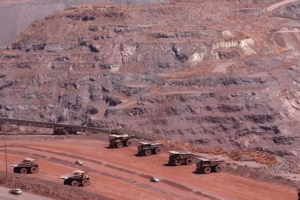
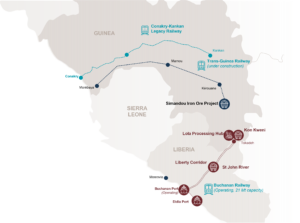
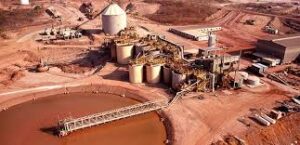
Pursuant to the ratification of Ivanhoe Atlantic rail and port access agreement (Concession and Access Agreement) by the Liberian legislature the US miner has been permitted to transport iron ore from its Kon Kweni project in Guinea to the Liberian port of Buchanan.The legislation followed 6 years of negotiations between US based Ivanhoe Atlantic and the Liberian government. The company successfully pitched its so-called “Liberty Corridor” between Guinea and Liberia as a counterweight to China’s so called “ predatory” dominance over critical minerals in Guinea’s Simandou region. Africa’s vast mineral wealth is at the centre stage of international power competition, as a newly developed high-grade iron ore deposit in Guinea draws the United States into a strategic confrontation with China over supply chains, infrastructure routes and geo strategic influence.
 Credit;Ivanhoe Atlantic
The US mining giant is scheduled to commence constructing Kon Kweni in early 2026 and begin shipments the following year, initially aiming for annual output of up to 5 million tons of high-grade iron ore. Liberia executed a US $ 1.8 billion agreement with US-based Ivanhoe Atlantic Inc. to rehabilitate and utilize its railway infrastructure for exporting iron ore from Guinea’s Kon Kweni project. Access to the rail will provide Ivanhoe Atlantic with the shortest export route for its Guinea mining project. The project targets initial production of 2-5 million tons annually , reaching up to 30 million tons.
Rival Project Simandou Ships Ore to China
 Credit;Business Insider Africa
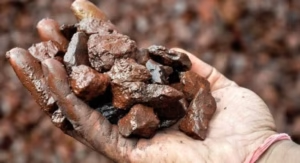
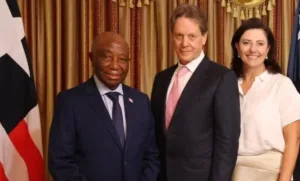
Guinea has commenced transportation by sea of cargoes of iron ore from a rival Simandou project, shipping about 200,000 tonnes of high-grade ore to China. Roughly 160 kilometres from Simandou a new iron ore deposit known as Kon Kweni has been identified in the mountains of Guinea operated by US Ivanhoe Atlantic. Bronwyn Barnes , President & Chief Executive Officer of Ivanhoe Atlantic , shared that every tonne produced is reserved exclusively for US and allied supply chains and none will go to China.

Liberian Rail Policy & Mining
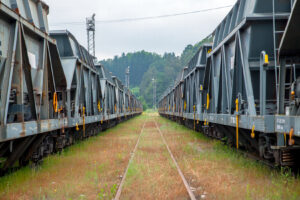
The Liberian rail policy emphasises on retaining logistical and financial sovereignty while simultaneously allowing transition of the existing Liberian rail infrastructure to a multi-user, independently operated grid opening up a valuable logistics chain to other users in Liberia and neighbouring countries, including US aligned companies seeking expansion into the region. The proposed transition will expand the Guinea-Liberia corridor to multiple users with an independent operator after ArcelorMittal Liberia’s exclusive agreement expires in 2030. The ratified Concession and Access Agreement provides access for Ivanhoe Atlantic Inc. to transport its ultra-high grade iron ore (> 67 % Fe) from its Kon Kweni project in Guinea, part owned by the Government of Guinea, to the Liberian Port of Buchanan using the Liberian Government owned Yekepa-Buchanan Rail Line.The required environmental impact assessments in Guinea and Liberia and are undergoing regulatory review. The 245 km Yekepa–Buchanan railway is a vital artery connecting Liberia’s mineral-rich east to the Atlantic Coast. Liberia is poised to avail its strategic advantage by positioning itself as a key trading hub in West Africa.
 Credit; mg_2765-vagones-de-carga-de-carbon-de-feve-en-la-estacion-de-figaredo-mieres-asturias-2016-e-u.jpg
Phased Investment by US in Port and Rail Infrastructure
Phase 1 of the project entails an estimated US $ 64 million investment for the rehabilitation and operational readiness of the existing railway and port infrastructure. Concession and other milestone payments after ratification will total US $ 35 million. Additionally, Ivanhoe Liberia will also contribute millions more in community development to impacted communities in Nimba and other counties. The phase II expansion envisages an additional US $ 888 million in direct capital costs, split between an estimated US $ 452 million railway upgrade and US $ 436 million expansion of Buchanan Port.
Infrastructure Development Investment
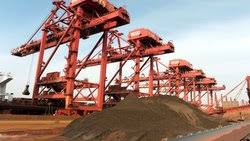
The infrastructure development will increase capacity on the railway to support the transportation of 30 million tons per annum (mtpa) of iron-ore from the Kon Kweni Iron Ore Project. The investment will include the construction of 22 km of dedicated haul roads, new bypasses, rail spurs and commercial quay mobilization at Buchanan Port. These commitments approach over a billion dollars in direct investment, likely to create hundreds of local jobs and establish a robust platform for multi-user, multi-commodity growth across Liberia. Ivanhoe Liberia has already made an access deposit of US $ 37 million to the Government of Liberia through the Central Bank between 2019 to 2022.
 Credit;The West Australian
Guaranteed Revenue Contribution
In 2022 Ivanhoe was acknowledged by the Liberia Revenue Authority (LRA) as a major revenue spinner. The concession and milestone payments as contained in Ivanhoe Agreement include :
US $ 1 million within 10 business days after signing of CAA
US $ 10 million within 10 business days after CAA takes effect
US $ 15 million upon unimpeded physical access to rail & port infrastructure
US $ 2.33 million on the date National Rail Authority Act enacted
US $ 3.33 million on date Independent Operator appointed
US $ 3.33 million on first anniversary of appointment of Independent Operator
 Credit ; Liberian Observer
According to the Concession Agreement these concession payments will be supplemented by dividends, taxes and duties that Ivanhoe Liberia will also pay throughout its use of the railway and port, excluding infrastructure investments. The project is part owned by the Government of Guinea and is expected to generate USD $ 16.7 billion for the Guinean government in its lifecycle in royalties, taxes and development fund contributions as well.
Emirati Mining Woes
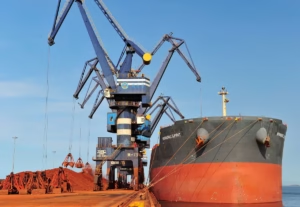
A United Arab Emirates (UAE) based company Axis International Ltd filed a $ 28.9 billion claim against Guinea at the World Bank’s International Centre for Settlement of Investment Disputes after the West African country recently revoked its permit to operate a bauxite mine .The African country Guinea, which has the world’s largest reserves of bauxite recently canceled multiple mining licenses for bauxite, gold, iron ore and diamonds revoking and reallocating some permits ostensibly seeking higher revenue and enhanced local share in processing of ores. The mine produced 18 million tons of bauxite in 2024.The Emirati (UAE) based company claims Guinea is liable for almost $28 billion in damages based on “proven reserves” of more than 800 million metric tons.
 Credit;Reuters
Canadian Mining Facing the Heat in Central Asia & Africa – Nationalisation
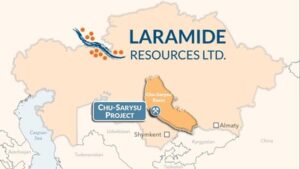
Map of Kazakhstan, showing project location in the Chu-Sarysu Basin (CNW Group/Laramide Resources Ltd.) – Credit
Canada’s Laramide Resources has withdrawn from a uranium project in Kazakhstan citing latest amendments to the Subsoil Code teeming it as “de facto nationalisation.” . Larmide considered such abrupt changes as pre-emptive measures to ensure national ownership and control of any new uranium discoveries before they are actually made. The new mining framework has enhanced the mandatory share of Kazhakistan national company Kazatomprom in new discoveries . Under the revised mining framework, Kazatomprom is granted priority rights over prospective uranium areas, stricter minimum ownership thresholds in new production agreements , enhanced control over extensions, reserve increases and additional exploration at producing deposits. Laramide Resources spokeperson stated that the latest changes to the Subsoil Code combined with higher holding costs and increased annual property taxes, undermine the investment rationale for continuing exploration in Kazakhstan . In a statement outlining the amendments Larmide highlighted the new provisions that raise the minimum ownership stake required in new uranium production agreements to more than 75 % up from 50 % previously, and impose additional conditions tied to technology transfer for extensions and reserve increases. Concerns have been voiced that what prevented Kazatomprom from entering these areas earlier or did it oversleep the geology especially when the avowed position is that Kazakhstan is investor friendly yet quasi-nationalization actions are resorted to.
Barrack Investment in Pakistan Unknown ?
 Credit;Dawn
The extent of investment in Pakistan’s Reko Diq Copper Gold project , situated at Chagai Balochistan by Barrick , is not available in the public domain. Hence the real contribution of Barrick to Pakistan’s mineral, financial, taxation and logistic sector is not clear apart from what Barrick chooses to share.

Credit;Barick Mining Corporation
Barick’s President and CEO Mark Bristow has shared that a financing pact with the World Bank and its commercial arm International Finance Corporation (IFC) was expected to be signed . The Asian Development Bank has , as per media reports , announced to invest in the project which is raising eyebrows as the President of ADB is from Japan and a likely conflict of interest may arise as Japanese companies have traditionally held significant stakes in copper mining and production. Barrick’s board had raised the possibility of splitting the company’s assets, which could include an outright sale of the Reko Diq mine and the company’s African assets . Although Barrick’s Anti-Bribery and Anti-Corruption statements are available on its website the manner ,duration, mechanism, third party involvement, international due diligence studies and mode of negotiations prior to acquiring the Reko Diq project are not available in the public domain.
Copper Gold Toxicity & CYANIDE
 Credit;Metso
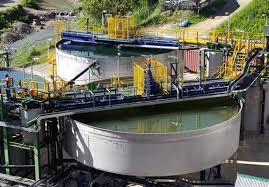
After panning , the refining of gold involves treatment by chemicals like Aqua Regia mainly nitric and hydrochloric acid for dissolution, sodium cyanide for leaching (cyanidation), borax/silica as fluxes during melting to remove impurities and form a purer gold button. The specific composition of chemicals is relevant to impurity level, with acids handling base metals whereas cyanide extracts gold from concentrates.
 Credit;DW
CYANIDATION TERRORISM
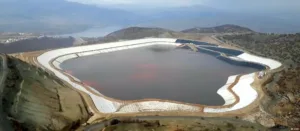
Sodium cyanide is a potent and rapid-acting poison that interferes with the body’s ability to use oxygen at the cellular level causing cellular hypoxia. Exposure can occur through inhalation of hydrogen cyanide gas, produced when sodium cyanide contacts water or acid, ingestion, or skin/eye contact and is fatal. Sodium Cyanide (NaCN) is commonly used in cyanidation (leaching) to dissolve gold from crushed ore both in large-scale mining and panning cleanup. Impoundments of toxic water containing cyanide could be a
target of terrorism and instances of breaching of tailings have been reported in Europe .Recently large quantities of cyanide solution spilled into the Karasu River in Turkey after a pipe carrying cyanide exploded in a gold mine. Almost 20 cubic meters (706 cubic feet) of toxic solution spilled into the Karasu River, a major environmental disaster.The Karasu river is 450-kilometer-long and a source of the Euphrates. As shared by DW mine operator Anagold Madencilik informed that the cyanide leakage contained 8 kg of cyanide . Health experts caution that ingestion of around 100 mg per cubic meter is sufficient to kill humans. Anagold Madencilik is a joint venture corporation between Canada-based SSR Mining and Lidya Madencilik, a subsidiary of the Calik Group.The company forecast $4.8 billion in operating income and $2 billion in net profit after 10 years in operation and royalties over the life of the mine will be approximately $ 198 million. Environmentalists told DW that the groundwater has become contaminated through the storage of oxidized ore and that mining activity had devastated forests, agricultural land, flora and fauna and heavy metals like arsenic part of the mining process are being discarded into the environment.
 Credit;Barben Analytical
Cyanide a carcinogenic compound ,is commonly used in the extraction of copper, gold and silver ores in Africa ,China and Pakistan without proper environmental regulation which causes the cyanide to seriously damage the health of miners and it seeps into the underground water reservoirs and acquifiers over large tracts thereby contaminating drinking water of communities . The cyanide used in the leaching process is recycled, but a certain quantity cyanide escapes into the tailing pond. Studies in Europe have demonstrated that bats and other animals drinking from these tailing ponds have been poisoned. There is a historical record of a dam holding a tailing pond being breached by flooding and subsequently releasing tons of cyanide into river systems causing an ecological disaster .Flooding is frequent in the province of Balochistan where copper , gold (Au) and Silver (Ag) mining is being carried out.Mercury is another lethal and toxic chemical used in artisanal mining and gold panning near Akora Khattak , Pakistan. Heavy mineral concentrates (HMC) occur along Indus river from Ghazi, Hund, Beka, Alladher and Kund in Khyber Pakhtunkhwa province and results have demonstrated that HMC have high Au contents, with values of 44.15 g/t and 39.15 g/t in Kund and Beka areas respectively with an average value of 15.18 g/ton and 11.37 g/ton . The placer gold deposits in Kund, Alladher and Beka are considered highly economical for the commercial exploration of placer or visible gold. Overall, the HMC derived from silt, sand, gravels and cobbles along Indus river indicates potential for placer gold that can be utilised for extraction of gold at commercial scale however no serious regulation or monitoring mechanism is in place to protect people, crops, animals and the aquatic environment from the cyanide and mercury elements being released into the streams , rivulets and rivers.
Cyanide Fatal to Aquatic Species
Cyanide is toxic and can be fatal to humans and animals if ingested in sufficient quantity.The greatest environmental threat from cyanide is to aquatic life from intentional or unintentional discharges into surface waters. Water monitoring and water management on mine sites are extremely important and regulations should explicitly limit the frequency and amount of cyanide which may be discharged into the environment.The World Wildlife Fund (WWF) and Food Agricultural Organisation (FAO) appear to be silent spectators to the damage being caused to crops , marine and aquatic species. There are a number of water treatment technologies available to remove cyanide from mine water .Cyanide has lethal effects even at low doses and affects humans through multiple pathways, including inhalation of hydrogen cyanide gas (HCN), ingestion of contaminated water or soil, dermal (skin) absorption, and consumption of contaminated crops or aquatic species. At Akora Khattak locals sell gold on the roadside cleaned by mercury which slowly burns skin. At artisanal sites, where safety protocols are lacking, miners and surrounding populations including children are frequently exposed to cyanide residue during ore processing or through proximity to polluted environments. Amid the progressive phase out of mercury following the Minamata Convention increasing reliance is being placed on cyanide with its lethal and environmental exposure risks . Unlike mercury, cyanide is sometimes perceived as less dangerous due to its rapid environmental degradation but such a perception tends to downplay the real risks posed by improper handling and chronic exposure. Acute (short-term) inhalation exposure to 100 milligrams per cubic meter (mg/m 3 ) of hydrogen cyanide may cause death in humans.

By Nadir Mumtaz
Trademark Blue Economy (IPO)
Credit :
http://Ivanhoe Atlantic media release
https://africa.businessinsider.com/local/markets/us-miners-develop-dollar18bn-high-grade-iron-ore-project-to-rival-chinas-dollar24bn/btsjlln
https://www.dawn.com/news/1903043
http://hydrogen cyanide will cause death in humans.
/2016-09/documents/cyanide-compounds.pdf
https://www.mdpi.com/1660-4601/22/7/1125
https://doi.org/10.46660/ijeeg.Vol10.Iss3.2019.324
https://www.dw.com/en/cyanide-spill-in-turkey-highlights-environmental-toll-of-mining/a-62293434
https://investingnews.com/laramide-exits-kazakhstan-uranium-project/

Leave A Comment