
High Seas Treaty
 Credit;US News
The High Sea Treaty, formally known as the Agreement on Biodiversity Beyond National Jurisdiction (BBNJ), entered into force on 17th January 2026 after acquiring the necessary 60 ratification threshold. The Agreement has so far been ratified by 81 Parties, including the EU and 16 of its Member States and signed by 145 countries. By signing the BBNJ a state does not yet accept any positive legal obligations under the treaty and only expresses its willingness to initiate the ratification process . The need for a fresh treaty was realised as expanding the mandates of existing agreements was likely to be time-consuming and unable to meet the comprehensive protection of high seas biodiversity. After entering into force the BBNJ establishes a mechanism to create marine protected areas (MPAs) on the High Seas, set clear obligations on how to ensure ocean resources are used sustainably, carry out capacity building , enable access to digital technology and tools and establish mechanisms to ensure equitable benefit-sharing of the oceans resources . This treaty will play a crucial role in achieving global biodiversity and climate goals including the target to protect 30% of the ocean by 2030. The BBNJ ambitiously aims to protect almost 10 million species from climate change, overfishing and deep-sea mining threats .
EU leads by Example
 Credit;European Commission
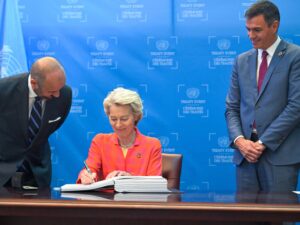
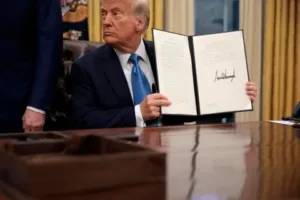
The President of the European Commission Ursula von der Leyen and Spanish Prime Minister Pedro Sánchez have signed the High Seas Treaty on behalf of the EU, leading by example and urging other countries to do the same. On the other hand US President Donald Trump has signed a controversial order to boost deep sea mining and encourage offshore drilling for hydrocarbons and scuttled an agreement to clean polluting fuels in shipping .The US has, in January this year, withdrawn from the United Nations Framework Convention on Climate Change (UNFCCC), the parent treaty underpinning all major international climate agreements. US President Donald Trump Trump openly scorned a scientific consensus that human activity is warming the planet and derides climate science as a “hoax.”
 Credit;Forbes
Countries not Ratified
China , Japan, Germany , Brazil and France have ratified the Treaty. The US with ocean-related goods exports of USD $ 61 billion signed the treaty but has not ratified it. India (ocean related exports at $19 billion) adopted the treaty in 2024 but domestic legislation on ratification is still pending. The UK has not ratified the treaty and Russia has neither adopted nor ratified the treaty. Pakistan signed the BBNJ in 2025 .
UNCLOS and BBNJ
 Credit;New Scientist
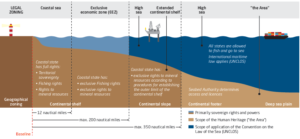
The United Nations Convention on the Law of the Sea (UNCLOS) entered into force in 1994 and regulates all uses of the seas and provides the legal framework for international ocean governance. The UNCLOS which is a legally binding UN treaty covers the ocean zones that lie beyond national waters (namely “high seas”) and the international seabed area. UNCLOS contains a special section on the high seas but it prescribes only general protective measures. There are some international conventions that address individual activities on the high seas and maritime navigation is regulated by the International Maritime Organization whereas high seas fisheries are regulated by the Food and Agriculture Organization (FAO) of the United Nations , United Nations Fish Stock Agreement and International Seabed Authority . In addition to these sectoral agreements, there are regional multilateral agreements whose scope extends to individual high seas areas. Currently about 8% of national waters are protected, but only 1% of the high seas.
Changes by BBNJ
 Credit;AWI
The agreement for protection of high seas biodiversity will allow legally binding guidelines and measures to be developed and implemented, with implications for other conventions and bodies with a mandate for the high seas. The BBNJ requires numerous reporting and compliance . Such information would then be stored and made available in a clearing house mechanism .The BBNJ is primarily an implementing agreement to UNCLOS oriented towards global marine conservation contributing to achieving international goals such as UN Sustainable Development Goal 14 “Life Below” . The BBNJ regulates the future use of marine genetic resources of the high seas scientifically identifying and designating “ protected areas “ in international waters. To be clear BBNJ does not regulate fishing or deep seabed mining on the high seas, for which stand-alone international agreements and bodies already exist .
 Credit;Revolve
Reporting by Maritime Nations
Maritime Policing
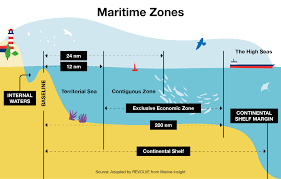
International waters outside the exclusive economic zones that typically stretch around 370 kilometres from countries’ coasts are sometimes known as wild areas as fishing is unregulated and huge depths represent almost 95 % of the habitat of marine species and fish . Controlling activities on the high seas is not easy however, the BBNJ requires member states to report all activities on the high seas. Such compliance would enable digital access and availability of reliable and accessible information on high seas commercial activities. The BBNJ contains articles on the settlement of disputes between member states yet there is no provision for the establishment of a “ maritime police force “ but each signatory state will seek to ensure that activities emanating from its territory or from vessels flying its flag comply with the new agreement. In a significant departure from the past decisions under the new agreement can be made by majority vote even if consensus cannot be reached in the negotiations thereby preventing decisions and resolutions from being blocked by individual member states. Marine protected areas can now be decided by a ¾ majority.
Plastic Pollution
Ocean , Mangroves & Forests as Carbon Sink
 Credit;European Commission
Plastic pollution is a concern being attributable to production of plastic and a lack of appropriate waste management strategies . Sunlight, mechanical abrasion and temperature fluctuations cause larger pieces of plastic to disintegrate into ever-smaller particles over time and upon reaching a size of 5 millimetres (referred to as microplastic). Such microplastics are ingested by a wide range of marine organisms in much greater amounts than larger pieces. The industrial ecosystem emits increasingly large quantities of carbon dioxide (CO2) which remains in the atmosphere causing global warming.The other half is absorbed by the ocean and by forests. The Greenhouse Gases dissolve poorly in warm water than in cold and accompanied by constant absorption of carbon dioxide affect the chemical balance of seawater causing “ ocean acidification” which is turn reduces the ability to absorb CO2. It is estimated that without absorbing and storing of CO2 by oceans and forests the current concentration of the greenhouse gas CO2 would enhance from 412 ppm (parts per million) to 600 ppm which would increase global warming.
Author : Nadir Mumtaz
Trademark Blue Economy (IPO)
Credit ;

https://www.scientificamerican.com/article/why-trumps-exit-from-pivotal-climate-treaty-matters/

Leave A Comment