China Taiwan US – Chips and AI
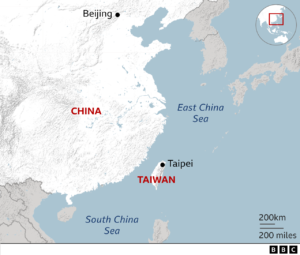
Taiwan (ROC) sits astride vital sea lanes of communication and international maritime commerce. The size of Taiwan is almost the same as Switzerland and is 390 km long , 140 km wide , total area 35,801 sq km , coastline 1566 km and comprises 84 islets and archipelagos as well .The Taiwan Strait links the East and South China Seas which serve as the maritime routes to access the Pacific and Indian Oceans.
 Credit:BBC
From a military perspective the Taiwan Strait is a “strategic thoroughfare ” that facilitates Chinese naval and air forces to transit between the Yellow, East and South China Seas, the three main bodies of water that form China’s “ near seas . Around 98 % percent of people in Taiwan are ethnic Han and the official language is Mandarin Chinese.
Chips War
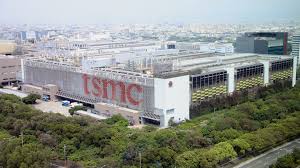
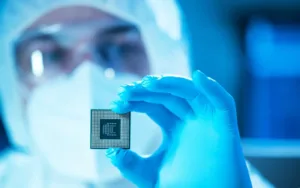
The Taiwan Semiconductor Manufacturing Company (TSMC) and ASE Technology Holding (ASEH) Company lead the world in wafer foundry , packaging and testing being two critical stages in the semiconductor manufacturing process, and is second globally in semiconductor design. Semiconductors ( integrated circuits or ICs) or popularly known as chips, are tiny electronic devices (based primarily on rare earth elements such as silicon or germanium) composed of billions of components that can process, store, sense and move and transmit data or signals. These chips are the brains of modern electronic devices ranging from everyday consumer devices such as smartphones, household appliances and computers to specialised equipment in sectors such as healthcare, automotive and defense. The IC’s comprised 62 % of Taiwan’s exports to mainland China (PRC) in 2023 , at a value of US $ 155 billion, according to China Customs data. The annual value of Taiwan’s investments in mainland China reached US $ 5.86 billion in the year 2021. Almost 42 % of Taiwan’s exports are destined for China from where Taiwan gets around 22 % of its imports. In the year 2020 goods and services worth USD $ 166 billion were formally traded between the two countries. China supplies key raw materials such as rare earths and low-end mass-produced electronic components, while Taiwan exports high-end semiconductors and optical components to China. Taiwan remains a significant investor in mainland China and according to Taipei in the period from 1991 to 2021 Taiwanese companies invested around $ 194 billion in a total of 44,577 Chinese projects. Taiwanese chipmaker Foxconn factories are leading examples of manufacturing of iPhones for Apple, Galaxy smartphones for Samsung and game consoles for Sony in plants scattered across China.
AI and Supply Chain
The AI demand exposes bottlenecks across global supply chains. Taiwan provides concentrated technology in fabrication, packaging, server assembly and components. While the US retains a significant role in the semiconductor design space, it has largely ceded manufacturing, assembly, testing, packaging and other elements of the supply chain elsewhere. Japan, South Korea and the Netherlands play vital parts in the semiconductor supply chain yet Taiwan is the undisputed leader in manufacturing. Over the past few decades Taiwan has grown and developed into a semiconductor manufacturing powerhouse producing over 60 % of global semiconductors with its leading semiconductor company TSMC accounting for 92 % of the world’s most advanced semiconductors. This concentration places the region as a stabilizing force as demand surges faster than infrastructure can adapt. Consistent performance reinforces Taiwan as the reference point for global AI manufacturing. Once manufacturing facility of semiconductors could be built for $50 million now however , a fabrication facility for advanced semiconductor chips can cost between $ 20-30 billion.
 Credit:CNBC
How the Story began
Taiwan’s semiconductor industry commenced with the 1976 transfer of chip manufacturing technology by Radio Corporation of America to Industrial Technology Research Institute (ITRI), a Taiwanese government sponsored entity and precursor to two key chip companies namely Taiwan Semiconductor Manufacturing Company and United Microelectronics Corporation . In 2021, Taiwan dominated almost 21 % of global semiconductor manufacturing capacity and significantly 92 % of manufacturing capacity for the most advanced chips. Taiwan has achieved this prominent role primarily through its foundries providing contract manufacturing services to other companies. Taiwan is home to 4 of the world’s top 10 foundries which comprise nearly 70 % of global foundry revenue in 2023. Across the ocean Silicon Valley was incubating numerous startups including Nvidia, Apple and Qualcomm yet interestingly none of these firms could afford foundries of their own at the time.
 Credit;The Yale Review of International Studies
Chinese Dominance in Rare Earth Elements
The close integration of Chinese digital technologies and the increasing role of China in exporting semiconductor materials (e.g., silicon, germanium, gallium arsenide, silicon carbide, gallium nitride, etc.) worldwide both pose potential risks in terms of China wresting control of the global semiconductor market prompting the the US Congress to pass the CHIPS and Science Act in 2022 which provided funding for the “Creating Helpful Incentives to Produce Semiconductors [CHIPS) for America Defense Fund” to implement initiatives for microelectronics research and development. The era of chips technology warfare has started .

Blue Economy Trademark (IPO)
Source ; Credit
https://www.theguardian.com/world/article/2024/jul/19/taiwan-semiconductor-industry-booming
https://www.stimson.org/2025/taiwan-up-close-why-geography-complicates-invasion/
https://www.spf.org/spf-china-observer/en/document-detail045.html
https://engelsbergideas.com/notebook/how-taiwan-won-the-semiconductor-race/

Leave A Comment