
United Nations Convention on the International Effects of Judicial Sales of Ships (New York, 2022) (the “Beijing Convention on the Judicial Sale of Ships”)
The Beijing Convention on the Judicial Sale of Ships (officially the UN Convention on the International Effects of Judicial Sales of Ships) officially entered into force on February 17, 2026. Developed by UNCITRAL and adopted by the UN General Assembly in 2022, this treaty addresses a long-standing legal headache: the risk that a new, rightful owner might still face claims or ship arrests from a previous owner’s creditors. The Beijing Convention on the Judicial Sale of Ships” establishes a harmonized regime for giving international effect to judicial sales, while preserving domestic law governing the procedure of judicial sales and the circumstances in which judicial sales confer clean title. By ensuring legal certainty as to the title that the purchaser acquires in the ship as it navigates internationally, the Convention is designed to maximize the price that the ship is able to attract in the market and the proceeds available for distribution among creditors and to promote international trade.
 Credit;Reuters
Key provisions
The basic rule of the Convention is that a judicial sale conducted in one State Party which has the effect of conferring clean title on the purchaser has the same effect in every other State Party (article 6). The basic rule is subject only to a public policy exception (article 10). The Convention regime prescribes additional rules which establish how a judicial sale is given effect after completion. The first is a requirement that the ship registry deregister the ship or transfer registration at the request of the purchaser (article 7). The second is a prohibition on arresting the ship for a claim arising from a pre-existing right or interest (i.e. a right or interest extinguished by the sale) (article 8). The third is the conferral of exclusive jurisdiction on the courts of the State of judicial sale to hear a challenge to the judicial sale (article 9). To support the operation of the regime and to safeguard the rights of parties with an interest in the ship, the Convention provides for the issuance of two instruments: a notice of judicial sale (article 4) and a certificate of judicial sale (article 5). It also establishes an online repository of those instruments which is freely accessible to any interested person or entity (article 11). The Convention regime is “closed”, in the sense that it applies only among States Parties (article 3), but “not exclusive”, in the sense that it does not displace other bases for giving effect to judicial sales, for instance under more favourable domestic law regimes (article 14). Under the Convention, a judicial sale conducted in one State Party is recognized by all other Parties. This grants the purchaser a “clean title,” free from prior debts or maritime claims, and gives new owners confidence that their ship will not be arrested later in a foreign port. To ensure transparency, each State where a sale occurs must issue a notice of judicial sale and, as appropriate, a certificate of judicial sale.
Role of International Maritime Organisation (IMO)
 Credit;PUNCH
The IMO plays a key role in implementation by serving as the repository for these instruments. They will be made publicly available through a dedicated module on the IMO’s Global Integrated Shipping Information System (GISIS) platform allowing all stakeholders to easily access harmonized information on notices and certificates of judicial sales. Previously, judicial sales of ships were governed by domestic laws, which varied widely between States. This treaty therefore represents a significant modernization that will reduce risk and friction in vessel transactions. By reducing legal risks and removing uncertainty, it helps strengthen the ship market, supports maximum pricing in the market and facilitates smoother international trade.
Yachts of Russian Oligarchs
 Credit;MEGAYACTH
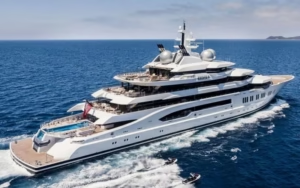
The U.S. government spends more than $ 7 million a year to maintain a superyacht it seized from a sanctioned Russian oligarch and is urging judicial authorities to permit it to auction the seized yacht “Amadea” before a dispute over its ownership is resolved. Authorities in Fiji seized the 348-foot (106 m) yacht (priced at $300 million) pursuant to a U.S. warrant alleging it was owned by Suleiman Kerimov, a multibillionaire sanctioned by the U.S. Treasury Department in response to Russia’s activities in Syria and Ukraine.
Co-authored by Hafiz Munawar Iqbal ASC and Nadir Mumtaz

Trademark Blue Economy (IPO)
Credit;
https://megayachtnews.com/2025/04/the-legal-battles-of-amadea-and-alfa-nero/

Leave A Comment