
Jetty at Port Qasim for Steel Mill
Pakistan Steel Mill (PSM) plant was initially set up in Karachi in 1968 and later upgraded with the aid of the United Socialist Soviet Republic (USSR). More than PKR 1 trillion were paid in taxes and duties by PSM in first 3 decades of its commercial production and in the period of 2000-01 to 2007-08 PSM earned around PKR 18 billion . The production capacity was 1.1 million ton of steel per annum with the main products being Coke, Pig iron, billets, Cold rolled sheet, hot rolled sheet and Galvanized sheets etc. The mills facilities are spread over an area of 19,088 acres . After PSM there has been only one large-scale investment in Pakistan’s steel industry namely the 1.5 million MT steel complex of Tuwairqi Steel Mill with the aim of supplying raw material to the rolling industry.
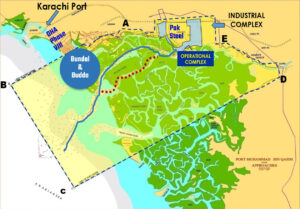 Credit;PQA
Collapse of Steel Mill
The PSM crises arose when the government decided to privatise in 2006 and it was apparently being sold below its potential value , a loss of PKR 26 billion. During the fiscal 2008-09 PSM recorded a loss of PKR 16.9 billion later reaching a staggering figure of PKR 118.7 billion . The PSM needs around 9000 employees to be fully operational and at one stage, the PSM had 30,000 employees. The Ministry of Industries and Production revealed in the Economic Coordination Committee meeting in the year 2016 that the Pakistan-China Free Trade agreement was a major factor behind PSM’s collapse as the trade agreement came into effect in 2007 .In the year 2014, the government released PKR 18.5 billion for PSM directing to increase capacity utilisation to 60% .However the production output during the years 2010-2015 was less than 40% of capacity and in 2014 plummeted to 6% of capacity. Ultimately the PSM was shut down in the year 2015 and remains a bleeding sore .
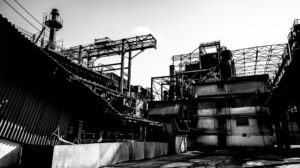 Credit;Propakistani
Year Wise Financial Losses of PSMC from 2008 to 2011
The Pakistan Steel Mills incurred a loss of PKR 29 billion from July 2008 to June 2009 . The mills’ liabilities as on 30 June 2009 were PKR 23.37 billion that rose to PKR 32 billion in 2009–2010 . Losses, misappropriation etc. from July 2007 till February 2009 were in the magnitude of PKR 39 billion . Massive losses were incurred by PSM in the fiscal year 2009 of around PKR 26 billion which were reduced to PKR 11 billion during 2010 . Again PKR 3.66 billion was the loss for FY 2011/12 .
Rare Earth Elements Minerals & AI
Emirates Global Aluminium (EGA) aluminium smelter and alumina refinery in the UAE sustained “significant damage” during attacks and its power plant was destroyed . EGA’s Al Taweelah annually produces 1.6 million tonnes of cast metal/bauxite being one of the largest single smelters in the world. Aluminium Bahrain was also struck . Aluminium producers in the Gulf account for around 9 % of global supply. Together these two plants supply around 21 % of US primary aluminium imports and prices surged to a four year high at $ 3,492 per tonne . China in the meantime retains an impressive inventory of aluminium ,operates smelters at full capacity, pays half of American energy costs per ton and faces no tariff wall into third-party markets making it extremely difficult for American and European producers to compete. To add to global mineral and hydrocarbon supply chain disruption satellite images depicted how Iraninan attacks caused fires at two pumping stations along the Habshan–Fujairah oil pipeline, a key route that carries crude oil from Abu Dhabi to the port of Fujairah while bypassing the Strait of Hormuz.
AI & Green Corporate & Critical Minerals
 Credit;The News
As electrification and digitalization gain momentum the supply of minerals and metals needed for electric vehicles (EVs), data centres and power grids is under increasing pressure. Demand is rising faster than new mining and refining capacity. Moreover refining is concentrated in a few regions and mining, refining, components and end products are interconnected . Sectors such as EVs require a supply chain for lithium and grids for copper and vanadium whereas sector of data centres’ essentially rely on rare earth elements including gallium and germanium . Batteries of EV’s require nickel manganese-cobalt and lithium – iron phosphate and the geographic footprint of upstream refining and processing determines costs of production . No doubt EV’s are ” Green ” . When gasoline touches $ 4 per liter car users in the US may flip to EV’s. The metal mass in EVs mainly comprises steel and aluminium. By the year 2035, data centres are projected to account for about 6% of global gallium use and around 2.4% of germanium demand. While relatively small in volume these minerals are critical to enable high performance computing. Servers and semi conductor chips despite being moderate in overall mass possess a compute layer with concentrates of high-value, high-purity materials comprising silicon, gallium, germanium, gold, silver and tin that sustain performance and reliability.
Pakistan has huge mineral resources and rare earth elements and should establish a reliable supply chain ,benefaction plants and smelters and occupy the global mineral production and supply gap . The window of opportunity is presently available, but for how long ?
Authored by Nadir Mumtaz
Trademark Blue Economy (IPO)

Credit:
https://tribune.com.pk/story/504258/private-sector-may-get-to-run-pakistan-steel-mills
https://naturalresourcesexchange.com/
https://reports.weforum.org/docs/WEF_From_Minerals_to_Megawatts_2025.pdf
https://www.bloomberg.com/news/articles/2026-03-14/iran-war-reignites-ev-interest-in-us-markets

Leave A Comment