
Damage to Irans’ Logistics Infrastructure as a Consequence of Iran – USA War
Iran’s transport network has been damaged extensively but not comprehensively destroyed. At Shahid Rajaee, Iran’s principal commercial maritime gateway, the available evidence does not establish widespread destruction of the main commercial berths or ship-to-shore container-handling system during the 2026 war. Instead, some of the clearest damage occurred in the road and railway infrastructure through which cargo moves between Bandar Abbas and the Iranian hinterland. At Chabahar, maritime traffic-control infrastructure was damaged or destroyed while the principal Shahid Beheshti commercial terminal remained physically intact. At Sirik and smaller coastal facilities direct waterside infrastructure damage was evident.
Iran’s Railways versus its Road Transport
Iran’s railway system suffered physical damage. The Aq Taqeh Khan railway bridge near Aqqala on the route toward Incheh Borun and Turkmenistan was damaged but safe railway movement was restored in less than a day. On the Tehran–Mashhad railway, one damaged running line was returned to service in approximately 15 hours. During the first 5 days of the war, Hormozgan port authorities reported an average 93 % decline in outbound truck movements carrying imported and transit cargo. At an observed low point, movements fell to approximately 165 trucks carrying 3,630 tonnes per day, compared with approximately 2,422 trucks carrying 53,284 tonnes per day after flows recovered toward pre-war levels.
Bab el-Mandeb Alternative to Strait of Hormuz
 Credit ; Trade Facilitation Network
The. U.S. Energy Information Administration data show crude oil and petroleum-liquid flows through the Strait of Hormuz declining from 21.6 million barrels per day in the 4th Quarter (Q4) of 2025 to 4.9 million barrels per day in Q2 2026, a reduction of approximately 77 % . LNG movements through Hormuz fell sharply, from 10.5 billion cubic feet per day to 0.8 billion cubic feet per day over the same comparison period. Alternative routing absorbed part of the oil shock and flows through Bab el-Mandeb increased from 5.4 million to 8.1 million barrels per day.
Sector wise Distribution of Iran’s Logistics
Higher oil and gas prices raise shipping and aviation costs thus freight and transportation costs rise. Higher natural-gas cost affect urea fertilizer production impacting agriculture supply chains and affordability of food products . Higher energy, freight, insurance and production costs eventually enter the prices incurred by businesses and are eventually passed on to consumers. Prior to the conflict, Iranian ports were handling approximately 235 million tonnes of cargo annually, including roughly 3.1 million TEU of container traffic. Iran’s road system was carrying approximately 600 million tonnes of freight annually. International road transit amounted to approximately 16.7 million tonnes, involving more than 742,000 international truck movements. The railway system was carrying approximately 40 million tonnes of domestic and international freight annually, including approximately 5 million tonnes of international rail transit. Pre-war published Iranian statistics placed its annual cargo throughput above 75 million tonnes, with figures for the year ending March 2025 exceeding 81 million tonnes.
Tunnels and Bridges Damaged
Published trade data associated approximately USD $ 29 billion of foreign trade with the gateway. This figure of USD $ 29 billion represents trade passing through the port. The evidence does not establish widespread destruction of Shahid Rajaee’s principal commercial container gantry cranes, quay walls or major commercial berths during the 2026 conflict. Independent reporting documents damage to at least 6 bridges and a tunnel around Bandar Abbas, together with a strike affecting a railway junction west of the city. Transport authorities subsequently reported restoration of the Bandar Abbas railway axis, reopening of a Shahid Mirzayi tunnel and activation of bypass arrangements around damaged road infrastructure. Marine-side installed capacity remained substantially available while the port’s landside evacuation system suffered significant impairment.
Indian Claims
During the first 5 days of the war, outbound truck movements carrying imported and transit cargo reportedly fell by an average 93 % . At one observed low point, approximately 165 trucks carrying 3,630 tonnes per day were leaving the port system and after recovery, movements reached approximately 2,422 trucks carrying 53,284 tonnes per day. The difference between the observed low point and the recovered level was therefore approximately 2,257 truck movements and 49,654 tonnes of evacuation capacity per day. More than 59,570 tonnes of essential goods and industrial raw materials were reportedly dispatched during those first 5 days using surviving port, road and railway capacity. There is apparently no corresponding destruction of the principal commercial berth, cargo yard or cargo-handling equipment at the India-operated Shahid Beheshti terminal and India subsequently claimed that the Shahid Beheshti terminal itself had not suffered physical damage which requires independent and third party verification. Since India began operations there, official Indian reporting indicates that the terminal had handled more than 3.11 million tonnes of bulk and general cargo and approximately 14,420 TEU.
Extensive Damage to Smaller Coastal Facilities
Sirik and smaller coastal facilities direct physical damage to waterside infrastructure was more clearly documented at some smaller facilities. At Sirik, a floating pier sustained serious damage. Other attacks affected smaller fishing and commercial pier facilities in Hormozgan. These incidents represent damage to the direct ship-to-shore interface, whereas much of the commercially important Bandar Abbas damage occurred in the hinterland network. Iran’s road freight system carries approximately 600 million tonnes annually, making it the country’s dominant inland freight mode by tonnage. International road transit has been approximately 16.7 million tonnes annually, involving more than 742,000 international vehicle movements. Damage to bridges and tunnels around Bandar Abbas therefore affected infrastructure serving not merely local traffic but a major port-hinterland and international transit system. Yet Iran’s international land network was not comprehensively severed. Important gateways toward Türkiye, Azerbaijan, Turkmenistan, Central Asia and Pakistan remained available or were restored.
Iran’s Aviation Sector
The damage to Iran’s civil aviation infrastructure was documented after Iran’s formal submission to the ICAO Assembly , which provides primary evidence concerning aviation infrastructure. Reported damage affected major airports and included radar, telecommunications, navigation equipment, runway surfaces and hangars. The primary surveillance radar supporting approach operations at Mehrabad was destroyed. Runway surfaces were damaged at Tabriz and Isfahan. Three hangars at Azadi were destroyed together with 38 private, leisure and training aircraft. A Red Crescent emergency medical helicopter was also reported destroyed at Zanjan. Air Cargo and Regional Aviation Air cargo represents a relatively small share of freight by weight but a disproportionately important share of high-value and time-sensitive trade. Pre-war Iranian airport statistics indicate six-month cargo volumes of approximately 42,300 tonnes at Mashhad, 41,700 tonnes at Mehrabad and 12,800 tonnes at Shiraz.
Alternative Routes to Strait of Hormuz
The oil system partially adapted and flows through Bab el-Mandeb increased from 5.4 million barrels per day in Q4 2025 to 8.1 million barrels per day in Q2 2026 as alternative export arrangements, including Saudi Arabia’s East-West pipeline and Red Sea outlets, absorbed part of the displaced traffic. These numbers demonstrate both shock and logistical resilience. Alternative routes prevented complete system failure. But alternative routes could not fully reproduce the capacity, distance or economics of normal Hormuz movements.
Iran’s Cargo Shifts
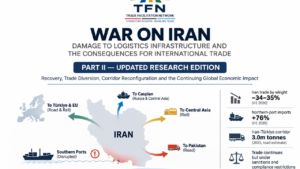
Iran’s Minister of Roads and Urban Development reported to Irans’ Parliament on 3 November 2026 that imports through northern maritime borders increased by 76% during the first half of 2026, while imports through land borders increased by 41%. Exports through northern ports increased by 10%, road-border exports by 9%, and railway exports by 53%, however the Minister acknowledged that alternative routes had not compensated for Southern port capacity. A further indication of the scale of disruption came from the head of Iran’s Trade Promotion Organization which reported in October that foreign trade by weight had declined by approximately 34–35% during the first half of 2026, while export value had declined by approximately 20%. Approximately 75% of Iran’s foreign trade by weight had previously moved by sea. These figures indicate that increased activity on alternative routes has not prevented a substantial contraction in physical trade.
Trade Continues at Iran–Türkiye–European Union Corridor
The Iran–Türkiye–European Union corridor emerges as one of the most strategically important components of Iran’s alternative trade geography. It provides an established land connection to Türkiye and, through the Turkish road and railway networks, onward access to European markets. It also offers a potential westbound connection for Central Asian cargo. The Caspian ports provide another important resilience mechanism, particularly for selected regional imports and exports. Yet their nominal capacity, vessel scale, cargo-handling characteristics and hinterland connections differ substantially from those of Iran’s southern ports. The European Commission reports EU–Iran merchandise trade of approximately €3.7 billion in 2025, comprising €3 billion of EU exports to Iran and €0.8 billion of EU imports from Iran. This demonstrates that bilateral trade continues hampered by a restrictive and complex legal environment. The EU sanctions framework includes restrictions relating to arms, dual-use goods, nuclear-related transfers, specified individuals and entities, financial transactions and certain transport activities. The reimposition of nuclear-related economic and financial sanctions in September 2025 further complicated commercial transactions.
TIR and eTIR potential
The UNECE’s 2025 roadmap identifies the Türkiye–Iran corridor as a high-priority international transport corridor. It records an estimated 107,000 TIR transports, based on previous years’ TIR carnet issuance. It also identifies potential to exceed 200,000 TIR transports through improved eTIR implementation and greater use of the system, based on estimates by Türkiye’s TOBB and Iran’s ICCIMA.
Pakistan–Iran Connectivity
Pakistan’s border with Iran offers potential for bilateral trade and wider regional connectivity particularly through Gabd–Rimdan and Taftan border crossings. However, developments in October 2026 demonstrated how quickly an operating route can become unavailable for commercial purposes. Pakistan suspended commercial trade through Gabd–Rimdan and Taftan on 17 October 2026 , withdrawing the waiver for the Electronic Inport Form (EIF) facility , as Pakistan’s banks do not transact with Iranian banks. Several hundreds of vehicles carrying LPG, rice, fruit and other goods were stranded. The Gabd–Rimdan reopened on 25 October, 2026 but the initial clearance was limited to consignments supported by consignment notes dated 16 October or earlier. Subsequent reporting described continuing uncertainty over new cargo dispatches, including difficulties associated with Pakistan’s E-Form procedure and related banking documentation. The overall situation remains hazy as there is no formal announcemen of border restrictions for cargo , and some logisticians claim the Iran – Pakistan border was never closed .
Credit ;
Trade Facilitation Network Trade Facilitation Network CONNECTING REGIONS. ENABLING TRADE.
Email: info@tradefacilitation.network
Website: www.tradefacilitation.network
https://www.linkedin.com/company/tradefacilitation/

https://unece.org/sites/default/files/2025-09/ECE-TRANS-WP30-AC2-2025-13e.pdf
https://www.trend.az/iran/society/3980581.html
https://www.consilium.europa.eu/en/policies/sanctions-against-iran/
https://www.tehrantimes.com/news/531788/Imports-through-northern-sea-borders-increase-by-76
https://www.tasnimnews.ir/en/news/2026/10/12/3721078/alternative-routes-cushion-iran-s-trade-decline
https://www.dawn.com/news/2039610
https://www.dawn.com/news/2037971/pakistan-closes-iran-border-crossings-for-trade
https://www.aljazeera.com/news/2026/10/26/has-pakistan-reopened-its-border-with-iran-for-trade
https://www.eia.gov/outlooks/steo/report/global_oil.php
https://www.iea.org/reports/gas-market-report-q3-2026
https://www.imf.org/en/publications/weo/issues/2026/10/13/world-economic-outlook-october-2026
https://www.worldbank.org/ext/en/country/iran
https://apnews.com/article/d7744d3063116944d49a616c007d669c
https://wanaen.com/bandar-abbas-railway-axis-restored-to-service-following-u-s-airstrike/
https://www.icao.int/sites/default/files/Meetings/a42/Documents/WP/wp_533_rev_en.pdf
https://www.unescap.org/sites/default/files/6E_Final%20report_TARWG.pdf?utm_source=chatgpt.com)
https://www.unescap.org/sites/default/files/Iran_8.pdf?utm_source=chatgpt.com
https://en.pmo.ir/?utm_source=chatgpt.com)
https://t.me/s/pmo_ir?q=%23IranPorts&utm_source=chatgpt.com)
https://t.me/s/rahbaraniran?utm_source=chatgpt.com)
(https://www.rai.ir/?utm_source=chatgpt.com)
(https://apnews.com/article/d7744d3063116944d49a616c007d669c?utm_source=chatgpt.com)
(https://www.chn.ir/transportation-economics/295299/?utm_source=chatgpt.com)
(https://airwars.org/incidents/usir260708c-july-8-2026?utm_source=chatgpt.com)
https://www.csis.org/analysis/irans-port-explosion?utm_source=chatgpt.com)
(https://www.eia.gov/outlooks/steo/report/global_oil.php?utm_source=chatgpt.com)
(https://www.eia.gov/outlooks/steo/report/energysecurity/article.php?utm_source=chatgpt.com)
https://www.iea.org/about/oil-security-and-emergency-ission/strait-of-hormuz?utm_source=chatgpt.com)
(https://www.iea.org/reports/gas-market-report-q3-2026?utm_source=chatgpt.com)
(https://portwatch.imf.org/?utm_source=chatgpt.com)
(https://unctad.org/system/files/official-document/gds2026d1_en.pdf?utm_source=chatgpt.com)
(https://www.elibrary.imf.org/display/book/9798229047999/CH001.xml?utm_source=chatgpt.com)
https://unctadstat.unctad.org/insights/theme/105?utm_source=chatgpt.com)
(https://www.fao.org/agrifood-economics/publications/detail/en/c/1758065/?utm_source=chatgpt.com)
(https://www.ft.com/content/83bdebe3-8f65-44e2-81b7-ecf133ca2929?utm_source=chatgpt.com)
(https://commonslibrary.parliament.uk/research-briefings/cbp-11075/?utm_source=chatgpt.com

Leave A Comment