
Icebreaker
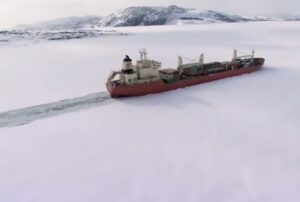
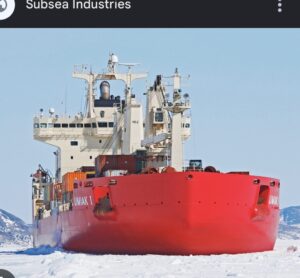
The icebreaking bulk carrier Umiak I is owned by Fednav a company which took to the water over 75 years ago . Known primarily for successful navigation of the Canadian Arctic, the company forged complex routes through unknown waters , mastering a multitude of complex routes on both the Great Lakes and the Arctic with an arsenal of close to 65 owned vessels.
Credit;Big Ships
Power of Icebreaker Ramming Ice
Umiak I was built in 2006 and is one of the most powerful of its kind. Its hull is reinforced to navigate unassisted through ice that is 1.5 meters thick. The vessel operates year round on the Labrador Coast, delivering supplies to remote mines and hauling nickel concentrate to southern facilities. On its regular run down the Labrador coast, Umiak I contends with some of the world’s most rugged ice conditions including icebergs, from November to July each year. While the open-water speed in a laden condition is some 13.5 knots, the bulk carrier is capable of making over three knots in level first year ice of 1.5-meter thickness. Its capability for effective ice ramming goes hand-in-hand with the ICE-15 classification. The ramming procedure entails sailing at a specified speed through the ice until the vessel is brought to a stop by the resistance of the ice. The vessel is then put astern to come free of the packed ice, and is then sailed full ahead, to break through the ice until brought up again by the force of resistance. The procedure is used for thick ice and ice ridges.
Fire Hazard
This particlar ship sails monthly on only one corridor which is 2100 km route from Quebec City to East Coast of Canada Labrador with a cargo of 30,000 tonnes of Nickel concentrate worth around USD $ 100 million. Such type of Nickel concentrate is self heating and if there is too much oxygen in the hull it may catch fire and in order to control such fire dangers Nitrogen gas is pumped into each of the four holds , which displaces the oxygen through a vent in the cover which requires constant monitoring of the holds. If the oxygen content in any of the holds exceeds 8 % that is a cause of concern.
Credit ;Subsea Industries
Strait of Belle Isle
The voyage usually takes 5 days .The ships reinforced hull can crush ice bridges 10 meters thick. Along the route multi year ice is encountered , from land connected ice to floating ice and icerbergs. The size of the ships rudder particularly makes turning convenient while docking in an ice quay . The hull is coated with a low friction paint to help ice and snow slide off. At times she may spray the ice with hundreds of gallons to soften the ice , yet may drag upto 30 meters of ice on both sides of the hull. During the voyage the ship passes through the Strait of Belle Isle located between Newfoundland and Labrador. The Strait of Belle Isle is 145 km long and 16 to 27 km wide and presents heavy ice cover, limiting the regular shipping season from June to late November for most shipping. Almost half of the journey takes place in the Inland Waterways .
Fuel
In open waters the bulk carrier burns around 35,000 liters of fuel daily and when ramming through ice she burns around 100,000 litres daily. At the destination the ship docks without any assistance from tugboats or harbour pilots .The ship dosent have a bow thruster and can’t use anchor in such conditions and uses its 30,000 horsepower engine and 46 ton controllable pitch propeller to dock alongside .Such pitch propellers allow angle changes without using reverse gear. Even the ice has to be flushed off the dock by the ship and the docking manoeuvre takes an hour.

Tredemark Blue Economy (IPO)

Leave A Comment