
Offshore Renewables Part 1
As part of the fabled “Blue Economy “the Indian Ocean is observing research being extensively carried out in the sphere of maritime oriented renewable energy sources. Proponents of offshore renewables are advocating marine ecologically compliant polices regulating maritime energy development, and concurrent institutional frameworks to assess environmental impact on marine habitats , stocks of marine species and endangered fish species at national and international levels.
Exclusive Economic Zones
Offshore wind energy in India rose from a nascent Indian ocean exposure or deployment of offshore infrastructure in India replete with social and environmental challenges. India’s large coastline comprises of an extensive offshore wind energy potential sustained by almost 2.3 million sq.km of exclusive economic zones .
Ultra Deep Offshore Oil and Gas Sector
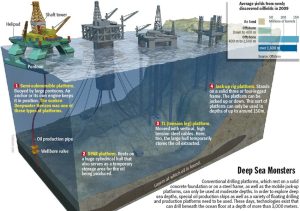
India is unique in the sense that it has 9 maritime states with the longest coastline being of Gujarat and then Tamil Nadu which is supportive for the oil and gas industry. In the offshore oil and gas sector advancement has taken place in the offshore energy infrastructure in India. India’s main hydrocarbon player the Oil and Natural Gas Corporation has been operating offshore oil and gas fields in Mumbai, known as “Bombay High ” , since 1976. On the eastern coast offshore field potential exists in the Krishna–Godavari– Mahanadi basin . The subsea joint venture project of Reliance and British Petroleum in the Krishna–Godavari basin was a relatively recent development enforced through installation of ultra-deep infrastructures for the extraction of gas.
 Credit Medium
Meeting Future Gas Needs
According to independent analysts the 3 recently developed deep water gas projects may supply around 15 % of India’s gas demand by the year 2023. India has been enterprising as evident from the oft touted “Deep Ocean Mission” focusing on exploring the sea bed and sub-sea minerals and energy and has allocated above 40 billion rupees albeit in a staggered manner.
Astronomical Costs Incurred in Andaman Islands Drilling
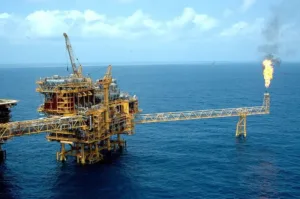
India’s state owned energy giant Oil and Natural Gas Corporation (ONGC) is drilling the first deepwater well in Mahanadi Basin to unlock the country’s offshore hydrocarbon potential aligned with Prime Minister Narendra Modi’s ‘Samudra Manthan’ (‘Churning of the Ocean’) mission , an initiative to explore the unexplored deepwater oil and gas potential. The Andaman deepwater region, which includes many others such as Krishna-Godaveri and Mahanadi , remains under-explored primarily due to associated costs and technical challenges, crippled by the lack of high-quality deepwater seismic data. Despite its geological promise and significant discoveries in the analogue basins the Andaman-Nicobar Basin has seen only a handful of exploration wells over decades. The sparse drilling activity underscores the historically limited industry interest with operators reluctant to commit capital in the absence of proven success.
 Credit;Offshore energy
The MN-DW18-1-H-D offshore exploration well in the Mahanadi Basin is being drilled approximately 23 nautical miles from Konark, off the Odisha coast. Its depth is 1623 meters. The Indian government recently opened nearly 1 million sq km of previously restricted offshore areas, creating fresh exploration opportunities through Offshore auction rounds under Open Acreage Licensing Policy, with deepwater and ultra-deepwater acreage. India’s eastern and western offshore basins, extending to water depths of up to 3,000 meters, are estimated to hold over 5,600 million metric tons of oil equivalent (mmtoe) of hydrocarbon potential. The daily cost of hiring an offshore rig is USD $ 250,000 and India’s ONGC plans to invest between $ 18 and $ 20 billion on new oil and gas drilling including hiring drilling rigs for what is seen as the biggest drilling campaign . The ONGC has provisioned for 150 offshore wells including contracting drillships and submersible rigs for up to 5 years. India is dependent on imported hydrocarbons, which for oil comes in at over 80 % and for natural gas around 50 % of consumption.
Bombay High
Bombay High was discovered in 1974 by ONGC , commercial production started in 1976 and it has served as the backbone of India’s domestic oil and gas production for decades . Bombay High is currently producing over 130,000 barrels per day and is a mature, shallow-water offshore oil and gas field off the west coast of India .The Andaman drilling represents a new deepwater frontier in the eastern Indian Ocean. Bombay High is Located in the Arabian Sea, about 162 km off the coast of Mumbai, Western India whereas the Andaman Basin is located in the Andaman Sea (Bay of Bengal region) off the East coast of the Andaman Islands in Eastern India. The Andaman Basin involves complex deepwater and ultra-deepwater drilling whereas Bombay High operates in relatively shallow waters at an average depth of about 75 meters (246 feet), utilizing fixed platforms attached directly to the seabed.
 Credit; Council-on-Foreign-Relations
Perseverence in Drilling Pays
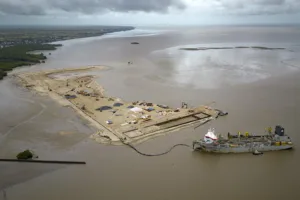
ExxonMobil and its co-venturers have produced the one billionth barrel of oil from Guyana’s Stabroek block 7 years after production began in 2019. Guyana is the world’s fastest growing energy producer. Guyana’s largely recoverable proven oil reserves are now estimated to be at about 11 billion barrels surpassing producers like Norway and ranking it among the world’s top 20 oil reserve holders. Most of these oil reserves are in the offshore area . In 2025 Guyana was producing roughly 900,000 bpd with capacity projected to reach around 1.7 million barrels per day by the year 2030. The country’s oil revenues exceed USD 8 billion yet disparity is evident amongst the populace.

Credit;
https://www.rystadenergy.com/insights/andaman-discovery-india-deepwater-gas-oil-exploration
https://www.cfr.org/articles/how-guyanas-oil-boom-will-reshape-energy-security

Leave A Comment