
Flooding Defences
Netherlands , an undisputed global leader in flood defense, spends around 1.3 billion Euros annually for diligently maintaining a sprawling network of sloped dikes, elevated ridges, windmills or polders, ditches, canals, concrete barriers and embankments to harness the raging waters. The anti-flood system built over decades is on a scale unmatched anywhere .
Sea Gate Rotterdam Port
The Dutch built a giant sea gate guarding the Port of Rotterdam, the largest port in Europe, a crucial logistical hub . The seagate has two curved arms which lock together and sink to the bottom, forming a 22-meter-high wall against the sea. The barrier is one of the largest moving structures and its two ball-and-socket joints, anchored in the embankment on either side of the canal, weigh 680 tonnes each.Till 2004 the 31,500 acre Rotterdam was the world’s busiest port by annual cargo tonnage, overtaken in 2004 by the port of Singapore and later by Chinese seaports.
Green Bonds & Coasts
In 2019 Netherlands launched a Euro Green Bond designed to fund projects to cope with current and future climate change impacts and an advanced
low carbon economy focusing on using coastal and river ecosystems as a
safeguard for negative climate impacts and high flood risk.The Green Bonds issue was oversubscribed by more than 15.2 billion Euros, reducing the risks of climate induced coastal flooding.
Urbanisation Land Reclamation & Flooding
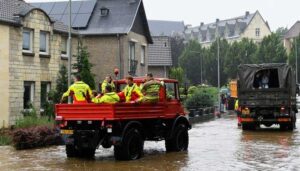
Netherlands is known for its low elevation and approximately two-thirds of its area is vulnerable to flooding. Deforestation, land reclamation works and building in the winter bed of rivers cause frequent flooding in the urban areas . In 1953 around 770 square miles of southern Netherland were inundated, forcing tens of thousands to flee. Over decades buildings, roads and cities were constructed leading to destruction of vegetation, deforestation , hence reducing the interception of rainfall in storms. Additionally, excessive use of tar and cement to pave roads and sidewalks inhibits water from infiltrating the soil increasing surface runoff. Such artificial structures are impermeable and water is forced to flow back into the ocean through surface runoff, increasing the peak discharge in the area. Due to this, the lag time for water to flow back into the ocean has decreased, increasing the chances of flooding. Due to land reclamation areas close to the shoreline become more prone to coastal waves. Erosion takes place resultantly and the fast-sinking land leads to floods.
 Credit;Reuters
Universities
Netherlands universities are producing some of the world’s best water engineers even exporting expertise abroad to China, Africa and Australia. The Netherlands operates around 2,000 water locks, essential for flood protection and global trade. These locks manage water levels, stop saltwater and lift ships. Unfortunately the lock at Badin ,Sindh province at the tail end of the Left Bank Outfall Drainage (LBOD) collapsed more then 25 years back and since then has not been replaced causing salt water intrusion through the estuary , gobbling up precious arable land . Reclamation at Karachi coast has casued flooding and inundation along the coast of Sindh province , as water finds its way back.

http://Credit; Encyclopedia Britannica The Guardian The News Jasper Daams

Leave A Comment